 >
>- Selamat datang di website PT Fiqry Jaya Manunggal. Semoga anda senantiasa sehat afiat. Kami siap melayani anda

Introduction to FEED (Front End Engineering Design)
Rp 7.950.000| Stok | Tersedia |
| Kategori | Engineering, Project |
29 Juni – 01 Juli 2026, Bandung
24 - 26 Agustus 2026, Bandung
Hotel Kimaya Braga, Bandung
Instructor: Ir. Deddy Nugraha
Introduction to FEED (Front End Engineering Design)
BACKGROUND:
Front End Engineering Design (FEED) is a crucial phase in the development of large-scale engineering projects, particularly in industries like oil and gas, petrochemicals, power, and infrastructure. This phase occurs after the conceptual design and before the detailed engineering phase. FEED focuses on defining the project’s technical requirements and laying the groundwork for a successful execution by ensuring all necessary aspects are well-understood and documented.
FEED helps establish a well-defined scope, budget, schedule, and identifies risks, resulting in greater success during implementation, start-up, and beyond. By undertaking FEED at the beginning of your project, you can minimize your overall project risks.
Through a FEED, you can realize:
- Lower lifecycle costs
- Reduced project technical, schedule and cost risks
- Faster time to achieve plant startup and turnover
- Reduced EHS and compliance risks
- Improved risk identification and mitigation
OBJECTIVES:
- Understand the purpose and importance of the Front End Engineering Design (FEED) phase in project development.
- Recognize the key differences between FEED, conceptual design, and detailed engineering.
- Identify the major components and deliverables of the FEED phase, such as process flow diagrams (PFDs), equipment layouts, and preliminary cost estimates.
- Grasp the basic steps involved in defining project scope and objectives during FEED.
- Appreciate the role of FEED in minimizing risks, controlling costs, and ensuring project alignment with business goals.
- Gain insights into how FEED influences subsequent project phases, including procurement and construction.
- Learn best practices and basic strategies for applying FEED principles in real-world scenarios.
Recommended Participants
- Project managers and engineers in oil & gas, petrochemical, and power industries.
- Professionals involved in planning, design, and project execution.
- Procurement & Logistic who involved in Procurement Project Management (PPM)
- New team members seeking foundational knowledge of FEED.
Course Outline
Introduction and Overview
Understanding FEED
- Definition and purpose of FEED.
- Role of FEED in the project lifecycle.
- Key differences between FEED, conceptual design, and detailed engineering.
Key Elements of FEED
- Overview of project scope and objectives.
- Importance of aligning FEED with business and project goals.
- Key deliverables of a FEED phase.
Simplified FEED Processes
Basics of Project Scope Definition
- How to define project requirements.
- Essential inputs for a successful FEED phase.
Introduction to FEED Deliverables
- Overview of typical FEED outputs:
- Process flow diagrams (PFDs).
- Equipment lists and layouts.
- Preliminary cost estimates.
Activity: Exercise on reviewing sample FEED deliverables.
FEED Best Practices and Practical Applications
Simplified Risk and Cost Overview
- Basics of identifying risks in FEED.
- Importance of preliminary cost estimation.
Transition from FEED to Execution
- How FEED influences the detailed engineering phase.
- Brief introduction to integrating FEED with procurement and construction.
Case Studies and Summary
- Real-world examples of successful FEED implementation.
- Key lessons learned from common FEED challenges.
Activity: Wrap-up discussion on how to apply FEED concepts in small-scale projects.
About The Course Leader
Ir. Deddy Nugraha, is a Senior Rotating Engineer and Asset Reliability specialist. Graduated from Mechanical Engineering Department, ITB (1990), and had advanced training in France and USA, for Gas turbine maintenance and repair. He brings extensive expertise in RCA and troubleshooting for Turbomachinery Equipment, as well as in Reliability philosophy, and serves as a SERIP instructor at Chevron-Riau. Additionally, he holds the position of General Secretary for both the Indonesian Reliability Society (ISR) and KMI.
Many consulting works has been conducted including in PT. Indonesia Power (Tambak Lorok, Suralaya, Perak), PT.IPMOMI Paiton, and, PT. PGN SBU TSJ and PT. Pertamina Gas, PT. HKS Humpus, and PT. Vale Indonesia. Operational excellence at PGN and railway safety management at the Minister of Transportation. Reliability Data collection in Geothermal Power plant Kamojang.
Introduction to FEED (Front End Engineering Design)

Remaining Life Assessment
BACKGROUND: Remaining life assessment (RLA) is an attempt to measure, predict the remaining life of an equipment, ie. a boiler or other critical equipment in a plant. By knowing the remaining life of an equipment or part thereof, technicians can plan replacement or repair. It is also very important aspect from safety, operation, and asset…
Rp 7.950.000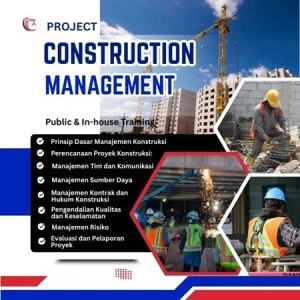
Project Construction Management
Project Construction Management atau Manajemen Konstruksi Proyek, merujuk pada proses perencanaan, pengorganisasian, pengelolaan, dan pengawasan semua aspek dari suatu proyek konstruksi. Tujuannya adalah untuk memastikan bahwa proyek konstruksi berjalan dengan efisien, tepat waktu, sesuai dengan anggaran, dan memenuhi standar kualitas yang ditetapkan. Project Construction Management adalah training yang dirancang untuk membekali peserta dengan pengetahuan dan…
Rp 7.950.000
Non-Destructive Examination (NDE)
BACKGROUND: Non-Destructive Examination (NDE) adalah metode inspeksi yang digunakan secara luas di berbagai industri, termasuk minyak dan gas, manufaktur, dan pembangkit listrik. Pengujian ini dilakukan tanpa merusak material atau komponen, sehingga penting untuk menjaga integritas operasional peralatan. NDE memberikan informasi tentang kondisi internal dan eksternal material, memungkinkan deteksi cacat lebih dini untuk meminimalkan risiko kegagalan….
Rp 7.950.000
Onshore Facilities Infrastructure, Design, Constructions & Operation Optimization
BACKGROUND: Onshore Facilities Infrastructure, Design, Constructions & Operation Optimization are one of the most complex systems among others. It requires team competent in fully integrated approaches starting from initial study, design planning, construction, startup operation and carry on to the post commissioning process. Ideally this includes post start-up review optimization and asset integrity management to…
Rp 7.950.000
Power Line Construction
Overview Power transmission is crucial to the power sector, as important as power generation itself. The electricity generated in power stations must be transported over long distances to reach load centers using transmission lines and towers. Expanding the Transmission & Distribution (T&D) network to meet growing demand is essential for providing a reliable, stable, and…
Rp 7.950.000
Flow Accelerated Corrosion
BACKGROUND: Flow Accelerated Corrosion (FAC) is a critical issue in industrial systems where high-velocity fluids interact with metallic surfaces, leading to accelerated material degradation. Commonly found in power plants, oil and gas operations, and chemical processing facilities, FAC poses significant risks to system integrity, safety, and operational efficiency. Left unaddressed, FAC can result in costly…
Rp 7.950.000