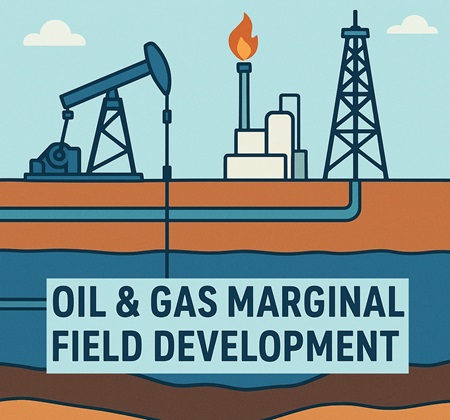
>
>- Selamat datang di website PT Fiqry Jaya Manunggal. Semoga anda senantiasa sehat afiat. Kami siap melayani anda
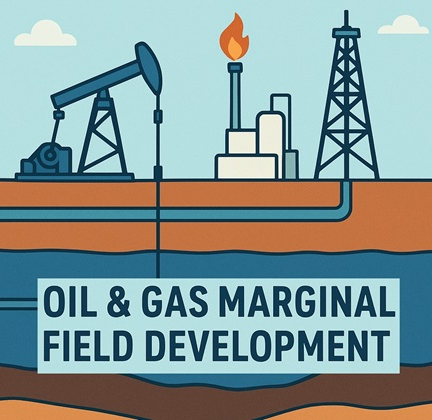
Marginal Field Development
Rp 10.950.000| Stok | Tersedia |
| Kategori | Oil & Gas |
22 - 24 April 2026, Bandung
07 - 09 September 2026, Bandung
23 - 25 November 2026, Bandung
Instructor : Prof. Dr.-Ing. Bonar Tua Halomoan Marbun
Marginal Field Development

Technical Solutions & Study Cases from Various Fields in Indonesia
BACKGROUND:
Marginal fields refer to discoveries which have not been exploited for long, due to one or more of the following factors:
- Very small sizes of reserves/pool to the extent of not being economically viable
- Lack of infrastructure in the vicinity and profitable consumers
- Prohibitive development costs, fiscal levies and or technological constraints
The various cycles which affect our oil industry have emphasized the need for detailed control of expenditure for development and production of such small discoveries. However, should technical or economic conditions change, such fields may become commercial fields. Marginal fields have several parameters that affect them. This includes environmental concerns, political stability, access, remoteness and, of course, the price and price stability of the produced gas/liquids.
This course will describe parts of unconventional methods to develop the marginal fields and mainly focus on innovative methods and new technology in developing those marginal fields.
OBJECTIVES:
- Recognize production & reservoir characteristics of marginal fields.
- Recognize the unique production & reservoir characteristics that define marginal fields & differentiate them from larger, more developed oil & gas assets.
- Understand the Improved Recovery Methods
- Understand the appropriate application of IOR (Improved Oil Recovery) methods to enhance production & maximize the economic potential of marginal fields.
- Identify under-performing wells or field areas & recommend appropriate intervention
- Determine the “upside potential” of a field, distinguishing between incremental reserves & reserve acceleration
- Describe the unconventional methods of developing marginal fields
- Describe all new technologies applied on the marginal fields
Recommended Participants
- Reservoir engineers
- Production engineers
- Drilling & Completion Engineer
- Development geoscientists
- Business Development, Asset team leaders, Acquisition & divestiture managers
Course Outline
- Marginal fields definition
- Why opportunities emerge; nature of reserves growth; operating practices and their effect on new opportunities; the contribution of evolving technology
- Recognizing opportunities, reservoir characteristics & production performance indicative of new opportunities, unravelling limited data and linking operator practices to new opportunities
- Novel wells for increased production rates, improved recovery and reduced cost
- Innovative facilities solutions to reduce capital & operating costs for marginal fields
- New technology/ the future of marginal fields
- Production optimization techniques that involve types of wells, well completions, artificial lift, stimulation methods, matrix stimulation & hydraulic fracturing methods
- Enhance Oil Recovery EOR and new technology; water injection/flooding; polymer flooding/ bright water and gas injection
- Case studies and possibility of new technology applications for various fields:
- PHR
- PHM
- PHE-ONWJ
- PHE-OSES
- PHE-WMO
- Conclusions and final review
About The Course Leader
Prof. Dr.-Ing. Bonar Tua Halomoan Marbun is a seasoned academic and industry expert with over 25 years of experience in petroleum and geothermal engineering. Currently serving as a Permanent Professor in Drilling Engineering at Institut Teknologi Bandung (ITB), he has held key academic leadership roles including Head of both Undergraduate and Postgraduate Petroleum Engineering Programs. His academic credentials include a Diplom-Ingenieur and Doctorate from Clausthal University of Technology, Germany, with research focused on drilling materials and unconventional cement systems.
Prof. Bonar has actively contributed to national and international energy sectors through consultancy, training, and policy advising. He has served as an Independent Safety Control Team member for Indonesia’s Ministry of Energy and Mineral Resources, and as a reviewer and expert for the U.S. Department of Energy. He is also an experienced instructor for Schlumberger NexT and a frequent speaker at industry training programs across Asia and Europe. His teaching and consulting portfolio spans companies such as Pertamina, Chevron, and SKK Migas, with specializations in drilling engineering, production optimization, and oil & gas regulations.
Marginal Field Development
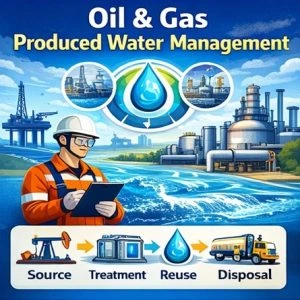
Produced Water Management
Background: Produced water merupakan fluida dengan volume terbesar yang dihasilkan dalam operasi minyak dan gas. Seiring meningkatnya usia lapangan, rasio produced water terhadap hydrocarbon cenderung meningkat dan menimbulkan tantangan teknis, lingkungan, serta biaya operasi yang signifikan. Dengan demikian Produced Water Management menjadi isu teknis, lingkungan, dan ekonomi yang kritikal. Pengelolaan produced water yang efektif membutuhkan…
Rp 7.950.000
POD, WP&B, and AFE
BACKGROUND: Kegiatan utama dan pertama bisnis hulu migas adalah mencari dan membuktikan keberadaan migas. Apabila cadangan berhasil ditemukan, maka selanjutnya keputusan investasi dan pengembangan akan ditentukan dengan mempertimbangkan hasil perhitungan keekonomian lapangan. Selanjutnya POD, WP&B, and AFE akan dibuat untuk pengembangan lapangan. Pada tahapan tersebut, PSC Planning sudah dimulai dan dibutuhkan. training akan diawali dengan…
Rp 14.750.000
Applied Reservoir Engineering
BACKGROUND: Petroleum Engineering practically covers: Production Operation, Drilling, and the core (Reservoir Engineering). This training represents the core of the reservoir engineering program. Numerous engineering practices are covered from fluid & rock properties to simulation & field development planning. As the core, Reservoir Department is the only one that normally cares about the live time…
Rp 10.950.000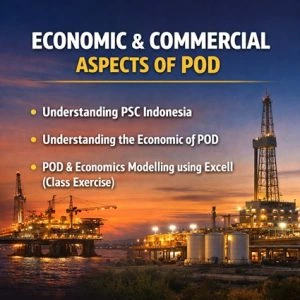
Economics & Commercial Aspects of POD
Background: Plan of Development (POD) of oil & gas fields represents a very complex problem and involves huge amounts of investments. POD is also one of the main business processes in Indonesia PSC besides Work Program & Budget (WP&B) and Authorization for Expenditure (AFE). Understand POD mechanism is very importance for anyone working on oil…
Rp 14.950.000
Enhance Oil Recovery (EOR)
INTRODUCTION: EOR (Enhance Oil Recovery)adalah metode perolehan minyak tahap lanjut dengan cara menambahkan energi berupa dari material atau fluida pendorong khusus yang tidak terdapat dalam reservoir minyak secara alami. EOR kabanyakan diterapkan pada lapangan atau sumur minyak tua yang telah kehilangan atau kehabisan tenaga dorong produksi dari sumur atau lapangan itu sendiri. Umumnya, EOR diterapkan…
Rp 10.950.000
Integrity Chemical Treatment and Selection
Background: Dalam industri migas, Integrity Chemical Treatment & Management menjadi fondasi utama dalam menjaga keberlangsungan operasi, efisiensi produksi, dan keselamatan kerja. Salah satu aspek penting dalam pengelolaan integritas aset adalah pemilihan dan penggunaan chemical treatment. Treatment ini tepat untuk mengatasi berbagai tantangan seperti emulsi, wax, scale, korosi, dan pembentukan hydrate. Ketepatan dalam diagnosis dan penanganan…
Rp 7.950.000