 >
>- Selamat datang di website PT Fiqry Jaya Manunggal. Semoga anda senantiasa sehat afiat. Kami siap melayani anda
Hazard & Operability Studies (HAZOPS) & Hazard Identification Study (HAZIDS)
Rp 11.950.000| Stok | Tersedia |
| Kategori | Maintenance, Project, Q-HSE |
15 – 17 April 2026, Jakarta
04 – 06 Agustus 2026, Jakarta
09 – 11 November 2026, Jakarta
Best Western Senayan, Jakarta
Instructor: Ir. Alfia Djabar
Hazard & Operability Studies (HAZOPS) & Hazard Identification Study (HAZIDS)
BACKGROUND:
HAZOP means hazard studies (HAZARD) & Operability. It is a systematic method of analysis of the operability parameters deviations using a specific vocabulary. The required documents in order to accomplish the study are the equipment sketches (PID, PFDs) and a process description.
HAZID- is a utilized technique for the identification of the significant hazards related to an operational activity. The study is based on key-words such as Control philosophy/ Flammable/ Toxic materials Hazards related to Electricity/ Security hazards/ Health hazards/ Hazards related to Height Safety Equipment – State of the Art/Operation philosophy (Manning, Training, etc.)
OBJECTIVES:
Upon completion of this course participants will:
- Understand the concept of risk and the risk management process
- Be able to provide a framework for HAZOP within risk assessment and an HSE Management System
- Be able to review the role of HAZOP within HSE project plans
- Be able to increase familiarity with HAZOP protocol, logic, structure and methodology
- Be able to describe the role and structure of the HAZOP Team and procedures
- Be able to introduce the role, responsibilities and conduct of a HAZOP Team Leader
Be able to provide sufficient hands-on experience in the application of HAZOP to different processes and systems
RECOMMENDED PARTICIPANTS:
Production and facilities managers, engineers (design, process, facilities, instrumentation and control), operations and safety of process operators, safety/environment personnel, plant operators, maintenance personnel
COURSE OUTLINE:
- HAZOP Method:
-
- HAZOP study Assumptions; HAZOP Review Applications; Ideal HAZOP Review Reference Data; Credible Scenarios or Causes; Non-Credible Scenarios or Causes; HAZOP Technical Suggestions; HAZOP Review Suggestions; HAZOP Recommendations and reporting; Administrative Controls; Engineering Controls; Approaches of Assigning Protection layers; Performance Based Approach; Prescriptive Approach API-RP-14C; HAZOP Workshop
- HAZARD Identifications
-
- Hazard Management Process; Factors Increases the Hazards Potential for Process Industries; Risk; Consequences; Voluntary and Involuntary Risk; Tolerable Risk in the industries; Evaluating the Risk; ALARP; Risk Matrices; Evaluating the Frequency; Evaluating the Severity; Evaluating the Overall Risk; Principals of Protective Measures; Risk reduction; Protection Layers; Prevention Layers; Mitigation Layers; Initiating event; Process Deviation; Loss of Containment or Release of Energy; Undesirable Events; Process Controls Vs Safety Controls; Separation of Process Control system and Safety control System
- HAZARD Analysis:
-
- Risk Criteria; Estimating Likelihood; Failure Modes; Safe Failures; Dangerous Failures; Detected/Undetected Failures; Random failures; Common Cause Systematic failures; Hazard Rate; Probability of Failure on Demand (PFD); Safety Instrumented System(SIS); Role of (SIS); Safety Integrity Requirement; Safety Integrity Level (SIL); Determining Safety Integrity Level (SIL); Risk Reduction and Reliability Assessment; Reliability Analysis; Voting And Redundancy; Diversifications; Risk Graph; Layer of Protection Analysis (LOPA); (LOPA) Procedure; Independent Protection Layers (IPLs); Fault Tree Analysis (FTA); Events and Gates
- Case Study
ABOUT THE COURSE LEADER:
Ir. Alfia Djabar, Facilitator for HAZOP, HAZID and SIL Classification study. Working experiences more than 30 years in oil & gas industries; 13 years at Chevron Pacific Indonesia in Duri Riau, 12.5 years at several engineering consultant in Jakarta with various positions (facilities engineer, process engineer, project engineer and project manager), and full time Facilitator since January 2018. Lead HAZOP, HAZID and SIL workshops more than 105 times for upstream oil & gas facilities, Pertamina refineries, detergent plant, and geothermal facilities. Experienced Excel VBA programmer and have developed dozen engineering calculation and data management: 1) control valve sizing (gas & liquid), 2) PSV sizing, 3) 2-phase and 3-phase separator sizing (vertical an horizontal), 4) Single & network hydraulic pipeline (gas & liquid), 5) Gas pipe noise prediction, 7) Employee timesheet for engineering projects, 8) Cause & Effect for searching and finding, 9) HAZOP and SIL Workbook packaged
Hazard & Operability Studies (HAZOPS) & Hazard Identification Study (HAZIDS)
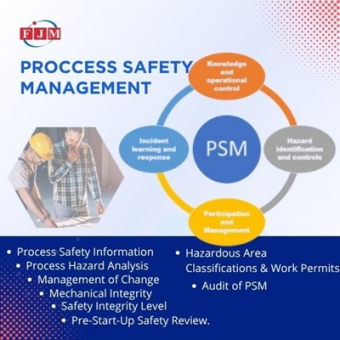
Process Safety Management
BACKGROUND Process Safety Management (PSM) atau Manajemen Keselamatan Proses (MKP) dilaksanakan oleh perusahaan-perusahaan atau industri kimia/ petro-chemical, minyak & gas bumi (migas) setelah beberapa kejadian fatal yang telah banyak menelan korban jiwa dan harta benda seperti kasus Flixborough (Juni 1974), Seveso (Juli 1976), Bhopal (Desember 1984), Piper Alpha (Juli 1988), dan lain sebagainya . Dalam…
Rp 7.950.000
Training dan Sertifikasi BNSP: Pengendalian Pencemaran Udara
BACKGROUND: Penanggung Jawab Operasional Instalasi Pengendalian Pencemaran Udara (POIPPU) adalah personil yang memiliki tugas dan tanggung jawab terhadap penyusunan rencana, pengoperasian dan pengoptimasian pengoperasian peralatan pengendalian pencemaran udara, perawatan peralatan pengendalian pencemaran udara, serta melaksanakan tanggap darurat dalam pengendalian pencemaran udara. Peraturan POIPPU: Berdasarkan Peraturan Menteri Lingkungan Hidup Dan Kehutanan Republik Indonesia Nomor. P.6/MENLHK/Setjen/Kum.1/2/2018 Tentang Standar…
Rp 8.950.000
Pemeriksaan & Pengujian Electrical Grounding system
BACKGROUND: Pemeriksaan & Pengujian Electrical Grounding system merupakan sistem vital dalam suatu bangunan apapun beserta peralatan yang ada di dalamnya. Kurangnya perhatian dan pemeliharaan terhadap grounding system mengakibatkan sambaran Petir menimbulkan kerusakan fatal pada peralatan, dan bahkan kebakaran. Pada industri padat modal seperti Refinery, Oil & Gas, Petrochem, Tank-yard kerusakan akibat petir dapat menimbulkan kerugian…
Rp 7.950.000
Pemeliharaan Proteksi Peralatan Elektrikal & Supervisory Pembangkit
BACKGROUND: Peralatan elektrikal pada pembangkit listrik merupakan elemen vital dalam menjaga kontinuitas operasi, keamanan, dan efisiensi sistem. Salah satu komponen utama dalam sistem elektrikal adalah proteksi peralatan yang dirancang untuk mendeteksi dan mencegah potensi gangguan atau kerusakan yang dapat menyebabkan downtime maupun kecelakaan kerja. Selain itu, sistem supervisory memastikan pengawasan dan kendali berjalan secara optimal…
Rp 7.950.000
Technical Projects Documents Management
BACKGROUND: Every good project produces documentation that is well organized and easy to find. Return when information is needed to proceed to the next project phase or operation/maintenance process. It can be done manually although using software is much better. Nevertheless, it is very important that it shall exist & well managed OBJECTIVES: This…
Rp 7.950.000
Maintenance and Reliability Management System (MRMS)
Background Dalam lingkungan industri yang semakin kompetitif, keandalan aset dan efektivitas sistem perawatan menjadi faktor penentu keberhasilan operasional. Banyak organisasi masih menghadapi tantangan seperti downtime tinggi, biaya maintenance membengkak, perencanaan yang lemah, serta rendahnya keandalan peralatan. Hal ini sering disebabkan oleh belum terintegrasinya sistem maintenance dan reliability secara menyeluruh. Maintenance and Reliability Management System (MRMS)…
Rp 9.500.000