>
>- Selamat datang di website PT Fiqry Jaya Manunggal. Semoga anda senantiasa sehat afiat. Kami siap melayani anda
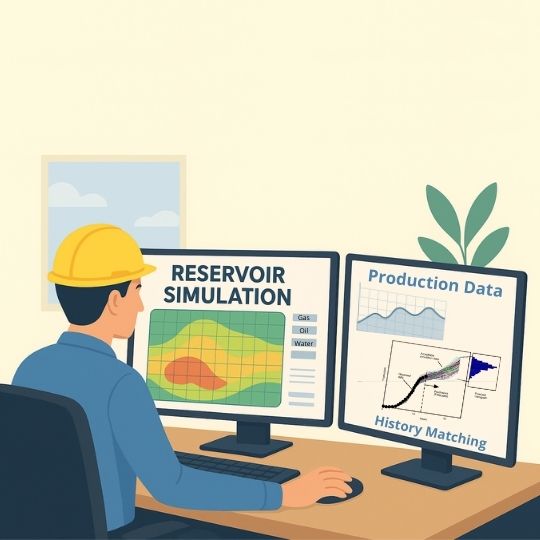
Reservoir Simulation
Rp 9.950.000| Stok | Tersedia |
| Kategori | 100+ Pelatihan Engineering & Migas Profesional 2026 | Sertifikat Resmi, Oil & Gas |
3-day training
Instructor: Prof. Dr.-Ing. Bonar Tua Halomoan Marbun
Reservoir Simulation
BACKGROUND
Production and operation teams cannot directly observe how conditions change within a reservoir during production. Instead, they depend on sophisticated simulation models that transform subsurface. Therefore, reservoir simulation serves as a cornerstone for understanding reservoir performance and optimizing recovery strategies. Integrating geoscience, production data, engineers can forecast future performance under various scenarios, identify operational bottlenecks, and design effective recovery schemes. Advances in gridding techniques, rock/fluid characterization, and model calibration have further elevated the accuracy and reliability of these predictions.
In recent years, the rise of data-driven modeling, machine learning, and advanced analytics has transformed how engineers approach simulation. These tools complement physics-based models by uncovering hidden patterns, enhancing predictive capabilities, and improving optimization in areas. Those areas can be fracture design, water/gas injection management, and predictive maintenance. It will equip participants with practical skills and integrated workflows to maximize reservoir performance in today’s competitive energy landscape.
OBJECTIVES:
This Course will discuss the following topics:
- Review of:
– Buckley Leverett displacement
– One dimensional water oil displacement
– Model components, types, and modern gridding methods
– Two-dimensional displacement
– Grid orientation and refinement
– Routine and special core analysis
– Single phase up-scaling of geo-cellular model parameters - Apply the principles of reservoir engineering to numerical modelling
- Set up, run, and analyse the results for single-well, pattern, and full-field models
- Prepare fluid and rock property data in the manner required for simulation studies
- Identify and eliminate causes of numerical problems
- Perform a history match
- Use the matched model to predict future performance under a variety of assumptions
- Introduction to advanced analytical tools and techniques that includes data mining and machine learning algorithms along with means to access them easily over open-source platforms – Python and Google’s Tensor Flow.
- Application of each of these tools to specific subsurface data and the successful implementation leading to optimization/decision making.
- Sweet spots/new acreage identification as well as likely optimum frac stages for unconventional production using existing reservoir data as well as public data.
- Application of artificial neural networks for a) predictive maintenance on surface facilities, b) identifying lithology by formation evaluation data and c) fluid characterization
- Optimize water and/or gas injection operations in conventional fields by application of these advanced tools on production data collected as part of surveillance
- Framework to integrate these advanced modelling tools with existing workflows such as reservoir simulation using case study to explain the same.
Recommended Participants
• Reservoir and production engineers
• Geo-scientist & subsurface technical professionals
• Managers involved in field-dev & optimization
• Engineers in data science teams working with oil & gas datasets
Course Outline
Fundamentals of Reservoir Simulation
- Classical analysis Vs Reservoir simulation overview
- Characterizing the reservoir
- Benefits of reservoir simulation
- Formulation of equations
- Linearization & solution process
- Minimum data requirements
- Well calculations
- General data requirements for reservoir simulation
Rock-Fluid Property Handling
- Handling of rock properties (porosity, permeability, saturation)
- Handling of rock-fluid properties (relative perm and capillary pressure)
- Simulation grids
- Local grid refinements
- Fine grid simulations
- Upscaling
- Tips on single well studies
- Tips on handling large simulation models
- Grid orientation and numerical dispersion
Compositional and Specialized Simulation Techniques
• Simulation types (Black-oil, MBO, Compositional, others)
• Overview of compositional simulation
• Applications of compositional simulation
• Data requirements for compositional simulation
• Computation considerations
Fractured Reservoir Modeling
- Types of fractured reservoirs
- Dual porosity fundamentals
- Fractured reservoir simulation
- Simulation walk-through to build dual porosity/dual permeability models
- DFN (Discrete Fractured Network) models
Practical Applications and Open-Source Software Practice
- Overview of simulation process
- Conducting a study
- Experimental design applications in reservoir simulation
- Assisted history matching
DELIVERY METHOD:
- Tutorial presentation
- In-class discussion
- Group discussion & study case
- Computer practice with open-source software (participant should bring own laptop)
About The Course Leader
Prof. Dr.-Ing. Bonar Tua Halomoan Marbun
Reservoir Simulation

Basic Process Safety for Operation Personnel
Background Industri proses seperti migas, petrokimia, pembangkit, dan manufaktur kimia memiliki potensi bahaya tinggi akibat penggunaan fluida berbahaya, tekanan dan temperatur tinggi, serta sistem operasi yang kompleks. Banyak kecelakaan besar di industri proses terjadi bukan hanya karena kegagalan peralatan, tetapi juga akibat kurangnya pemahaman personel operasi terhadap prinsip dasar process safety. Process safety berbeda dengan…
Rp 7.950.000
Pipeline Corrosion & Scale Integrity Management
BACKGROUND: Scale and Corrosion di lapangan Oil & Gas Field merupakan tantangan utama yang dapat mengurangi efisiensi operasi, meningkatkan biaya pemeliharaan, dan memperpendek umur peralatan. Scale terbentuk akibat pengendapan mineral di dalam sistem, sementara korosi merusak struktur material akibat interaksi dengan lingkungan yang agresif. Masalah ini tidak hanya memengaruhi produktivitas, tetapi juga membawa risiko terhadap…
Rp 7.950.000
Operasi Sistem BOP (Balance of Plant) Pembangkit Thermal
BACKGROUND: Pembangkit Listrik Tenaga Uap (PLTU) berbahan bakar batu bara merupakan salah satu tulang punggung penyediaan energi listrik di Indonesia. PLTU bekerja dengan mengubah energi panas dari pembakaran batu bara menjadi energi listrik melalui berbagai tahapan sistem yang saling terintegrasi. Dalam operasinya, keberhasilan pembangkit ini sangat bergantung pada kinerja komponen utama dan sistem pendukungnya. Salah…
Rp 7.950.000
Failure Mode and Effect Analysis (FMEA)
BACKGROUND: Failure mode and effect analysis adalah alat yang sangat bermanfaat untuk mencegah kegagalan proses dan produk. FMEA adalah metoda untuk mengidentifikasi dan mengevaluasi kegagalan potensial, menentukan tingkat resiko dari dari kegagalan dan skala prioritas untuk mengambil tindakan yang diperlukan. FMEA dapat menekan biaya karena kegagalan produk. Lebih dari itu, FMEA dapat berfungsi sebagai database…
Rp 7.950.000
Gas Handling, Conditioning and Processing Facilities
BACKGROUND: Pengelolaan gas alam merupakan aspek kritis dalam operasi industri minyak dan gas, yang mencakup proses penanganan, pengkondisian, hingga pengolahan gas. Fasilitas gas membutuhkan pemahaman teknis mendalam untuk memastikan bahwa setiap tahapan dilakukan secara aman, efisien, dan sesuai dengan standar yang berlaku. Dengan semakin kompleksnya teknologi dan peralatan yang digunakan, serta meningkatnya tuntutan akan efisiensi…
Rp 7.950.000
Advance Vibration Analysis
Background: Basic Vibration Training provides just the basic knowledge of vibration, while Advanced Vibration Analysis should have wider spectrums. Some of those wider spectrums are: root-cause analysis/diagnosis & precise corrective recommendations; report writing & recommendation. Participants will be trained not only to recognize vibration symptoms, but to accurately diagnose root causes and provide precise corrective…
Rp 10.950.000