>
>- Selamat datang di website PT Fiqry Jaya Manunggal. Semoga anda senantiasa sehat afiat. Kami siap melayani anda
Formation Damage, Well Stimulation
Rp 10.950.000| Stok | Tersedia |
| Kategori | Oil & Gas |
Trainer: Prof. Dr.-Ing. Bonar Tua Halomoan Marbun
Bandung: 21-23 April, 2026
Bandung: 9-11 September, 2026
Bandung: 10-12 November, 2026
Formation Damage, Well Stimulation
Background:
Formation Damage & Well Stimulation is just like a twin children. Formation damage is a common and often unavoidable issue that reduces well productivity and injectivity throughout drilling, completion, production, and workover operations. And Well Stimulation may need to come after. Improper fluid selection, solids invasion, fines migration, scaling, and organic deposition frequently result in near-wellbore impairment, particularly in mature and challenging reservoirs.
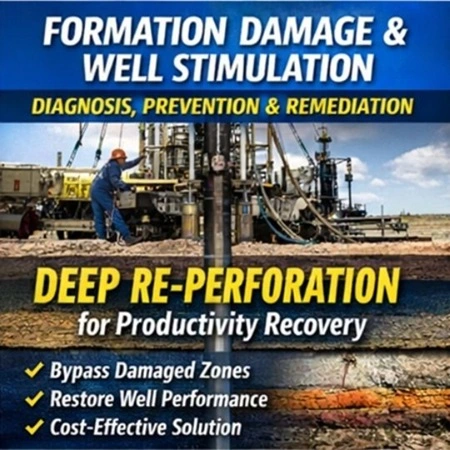
In many cases, productivity losses caused by formation damage do not always require costly stimulation treatments such as acidizing or hydraulic fracturing. Practical field experience shows that deep re-perforation, when properly designed and executed, can effectively bypass damaged zones and restore well performance by reconnecting the wellbore to undamaged reservoir sections. However, when damage extends deeper into the formation or reservoir quality is inherently low, well stimulation techniques become necessary to enhance flow capacity.
This training provides an integrated understanding of formation damage mechanisms and well stimulation options, enabling participants to select the most technically and economically appropriate solution—from prevention and remediation to stimulation—based on reservoir conditions and well objectives.
Objectives:
• Understand formation damage mechanisms in sandstone, carbonate, and shale reservoirs
• Identify damage sources throughout the well lifecycle
• Diagnose formation damage using production data, pressure analysis, and logging tools
• Evaluate remediation options including deep re-perforation, non-acid treatments, and stimulation
• Select appropriate well stimulation methods such as acidizing or hydraulic fracturing when required
• Improve well productivity and injectivity through effective damage management and stimulation strategies
Recommended Participants:
Designed For & Applicable To:
• Production, Completion, Reservoir, and Drilling Engineers
• Petroleum & Geological Engineers
• Field Supervisors, Production Foremen, and Engineering Technicians
• Asset, Production, and Reservoir Management Personnel
Applicable for professionals involved in:
• Vertical, horizontal, and multilateral wells
• Oil, gas, and injection wells
• Conventional and unconventional reservoirs
Course Outline:
1. Formation Damage Fundamentals
- Geological and depositional environment review
- Reservoir rock and fluid properties
- Clay mineralogy and its impact on formation damage
- Formation damage mechanisms in sandstones, carbonates, and shales
- Damage sources during drilling, completion, perforation, production, and workover
2. Formation Damage Evaluation & Diagnosis
- Laboratory testing and damage potential assessment
- Production performance analysis
- Pressure transient analysis
- Production and injection logging
- Identifying damaged wells and candidate selection
3. Formation Damage Prevention & Remediation
- Fluid compatibility and best operational practices
- Damage prevention strategies
- Non-acid remediation techniques
- Deep re-perforation as a damage bypass method
- Limitations and economic considerations
4. Well Stimulation Fundamentals
- Objectives of well stimulation
- Stimulation versus damage removal
- Candidate selection and treatment objectives
5. Acidizing Treatments
- Matrix acidizing concepts
- Sandstone and carbonate acidizing
- Acid systems, additives, and risks
- Post-treatment evaluation
6. Hydraulic Fracturing Overview
- Fracturing principles and objectives
- Fracturing as a damage bypass and stimulation technique
- Small-scale fracturing for productivity enhancement
- Operational and reservoir constraints
7. Post-Treatment Evaluation
- Production and pressure response analysis
- Success indicators and common failure causes
- Lessons learned and best practices
Delivery Method:
• In-class tutorial & theory
• Video presentation
• Discussion & study case on real field experiences
About The Course Leader
Prof. Dr.-Ing. Bonar Tua Halomoan Marbun
Formation Damage, Well Stimulation

Downhole & Surface Production Equipment
BACKGROUND: Optimizing Oil and Gas Production: Downhole and Surface Equipment In oil and gas production, the seamless operation of both downhole and surface production equipment is essential for efficient hydrocarbon extraction and transportation. To begin with, downhole equipment encompasses the tools and machinery located beneath the earth’s surface, which are pivotal for extracting oil or…
Rp 12.950.000
PSC Business & Profit Sharing Funds
Background: Production Sharing Contract (PSC) is the most widely used contractual framework in the oil and gas industry to regulate the relationship between host governments and contractors. Under this scheme, in the upstream oil & gas business Government retains ownership of natural resources, while contractors are entitled to recover costs and share profits according to…
Rp 14.950.000
Surface Wellhead System
Background The surface wellhead system plays critical role ensuring safe & efficient control of hydrocarbons from the reservoir to processing facilities. Positioned on surface, wellhead serves as the primary interface between subsurface operations & topside facilities. It provides structural and pressure control throughout the well’s life cycle. Among its key components, the Christmas tree enables…
Rp 6.350.000
Petroleum Engineering for non Petroleum Engineer
BACKGROUND: Training Petroleum Engineering for Non-Engineering merupakan salah satu pelatihan bidang kompetensi untuk sektor minyak dan gas yang sangat direkomendasikan diikuti oleh para pekerja pada sektor minyak dan gas dengan latar belakang non-engineering. Dalam pelatihan ini akan dibahas dasar-dasar dalam teknologi pengolahan minyak dan gas dan mampu melakukan analisa-analisa serta prinsip dasar dalam pengolahan data…
Rp 7.950.000
Advanced Centrifugal Compressor
BACKGROUND: This training course will be presented as PowerPoint Presentations, discussions drawn from many years of operation and maintenance experience working around the world. Questions and examples based on past experiences will be used throughout this presentation and participants are encouraged to ask questions and discuss examples from their own experiences. OBJECTIVES: This Centrifugal…
*Harga Hubungi CS
Lifting Operation Oil & Gas
BACKGROUND: Lifting operation adalah usaha yang dilakukan oleh production engineer dan tim production engineer untuk mengangkat minyak dan gas dari dasar sumur ke permukaan, baik melalui sumur sumur alam (natural flow) mau pun sumur – sumur buatan (artificial lift). Biasanya artificial lift yang sering digunakan adalah Gas Lift well, Sucker Rod Pump well, Electric Submersible…
Rp 14.950.000